
Cold Plunge 101: What Nobody Tells You Before You Buy - The cold plunge market is booming — and so is the misinformation. Here's what actually separates a $500 tub from a $5,000 system, and why it matters more than you think
You've seen them everywhere. On Instagram. In celebrity homes. In your favorite athlete's recovery routine. Cold plunges have gone from niche biohacker gear to mainstream wellness must-have practically overnight — and with that explosion in popularity has come an equally explosive amount of confusing, contradictory, and sometimes flat-out misleading product information.
So let's fix that.
This guide gives you the real story on cold plunge systems: what the different types actually are, what specs matter, what the marketing glosses over, and how to make a decision you won't regret.
Not All Cold Plunges Are the Same Product
This is the single most important thing to understand before you shop. "Cold plunge" is an umbrella term covering four fundamentally different product categories. Treating them as interchangeable is like comparing a kiddie pool to a lap pool because they're both filled with water.
The Ice Bath: Where It All Started
The original cold plunge is exactly what it sounds like — a vessel filled with cold water and ice. Stock tanks from farm supply stores became a cult favorite among athletes and biohackers for one reason: they work, and they cost next to nothing.
The reality check: ice is expensive. If you're doing daily cold exposure at 10 minutes per session and using a bag of ice each time, you're spending $300+ a month. The temperature creeps up during your session and between sessions. There's no filtration — the water needs to be changed frequently. And you're managing all of this manually, every time.
Ice baths are a great way to test whether cold exposure is for you. They're not a long-term solution for anyone who gets serious about it.
The Chiller System: The Real Product
This is what serious cold plunge buyers are actually purchasing, and it's where the market gets interesting.
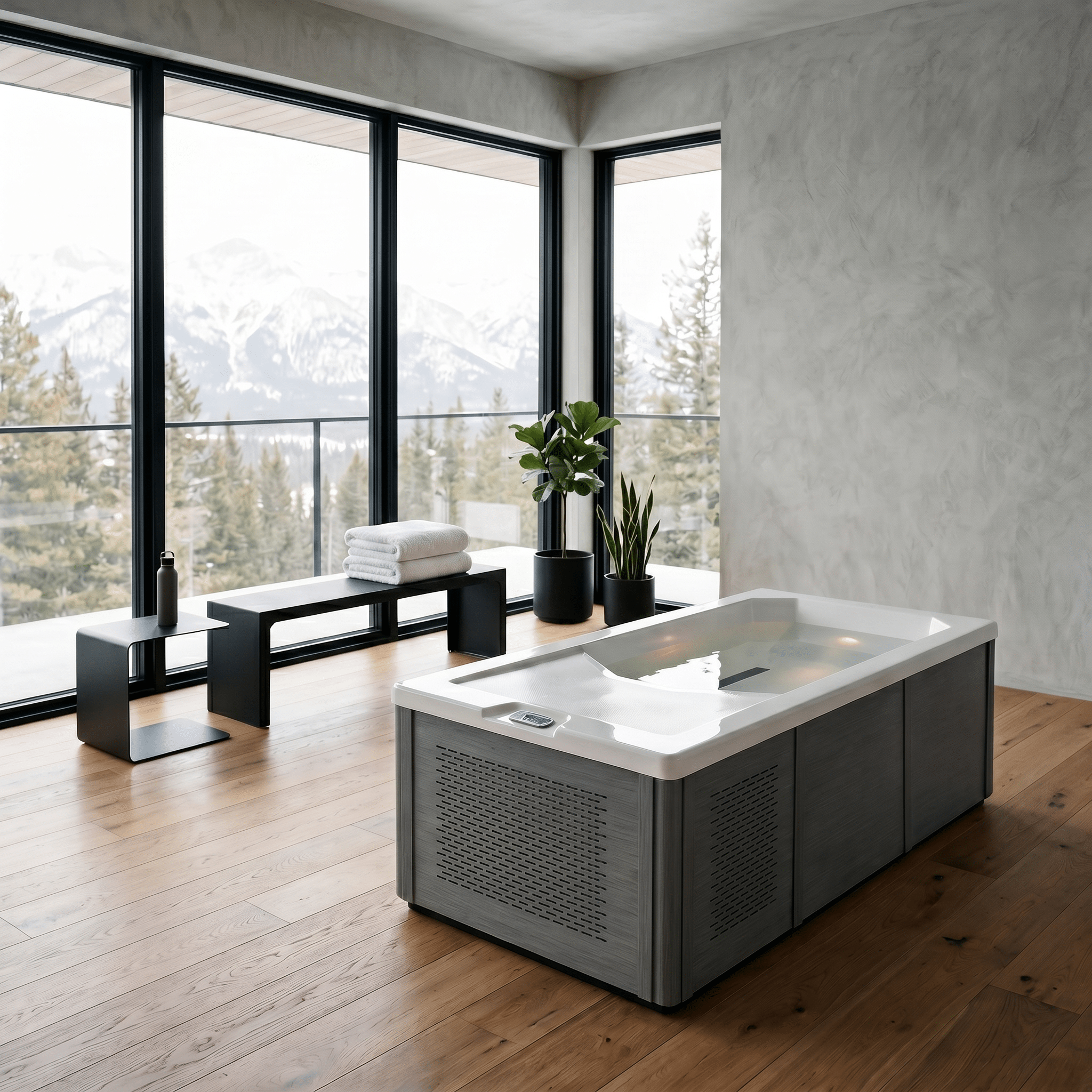
A chiller-based cold plunge is a refrigeration system connected to a plunge vessel. The chiller — essentially the same technology inside your home refrigerator, scaled up — removes heat from the water continuously, maintaining a precise temperature you set and forget. No ice. No guesswork. You dial in 50°F, it stays at 50°F.
This is a fundamentally different product from an ice bath, not just a fancier version of one. The experience is consistent and repeatable. The operating cost over time is significantly lower than daily ice purchases. And the build quality at the mid-to-high tier is genuinely impressive.
This is where the $2,000–$15,000 price range lives, and where most of the quality differences that matter actually show up.
What's Inside a Chiller System — And Why You Should Care
Most buyers look at a cold plunge and see a tub. What they should be evaluating is a refrigeration appliance with a tub attached. Here's what's actually inside.
The Vessel: What You Sit In
Stainless steel is the premium standard, and not all stainless is the same. There are two grades to know:
- 304 stainless is what most stainless plunges use — excellent quality, appropriate for indoor applications.
- 316 stainless (marine-grade) is required if you're using a salt sanitation system or installing outdoors in a humid coastal environment. It costs more, but it won't corrode. If a supplier can't tell you which grade they're using, that's a problem.
Gauge matters too. 14-gauge stainless is premium. 16-gauge is standard. Anything thinner is a sign of cost-cutting that will show up over time.
Rotomolded polyethylene is the material used in many of the most popular mid-market plunges — rugged, lightweight, UV-resistant, and well-insulated. It doesn't have the premium visual weight of stainless, but it performs extremely well and handles outdoor conditions beautifully. Don't dismiss it based on aesthetics.
Acrylic and fiberglass offer a smooth, comfortable interior and good insulation. Common in spa-style plunges. More shape variety. Slightly less "serious" visually than stainless.
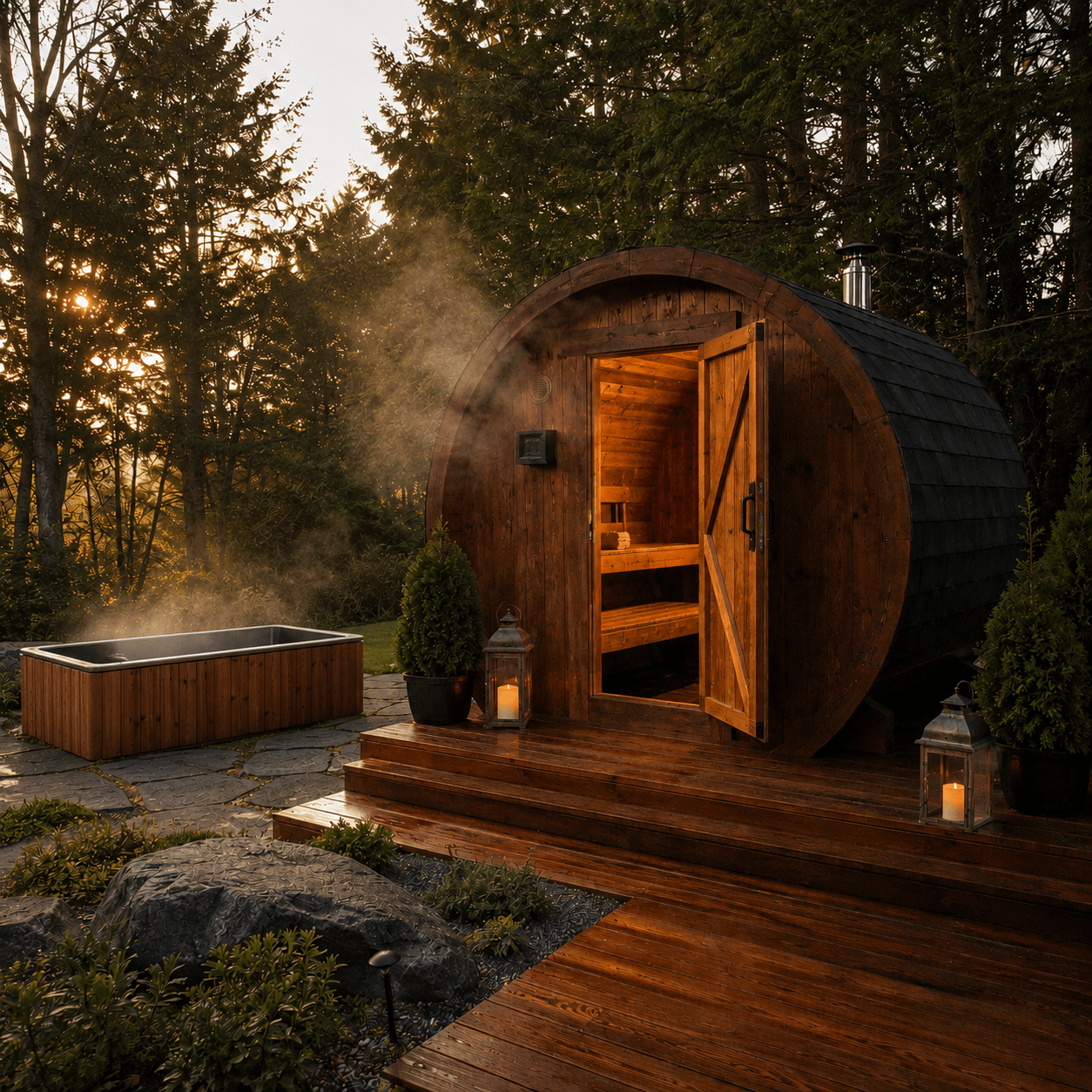
Wood-wrapped vessels — cedar or thermowood wrapped around a fiberglass or acrylic inner vessel — are primarily an aesthetic choice. The wood doesn't contact the water. They look stunning paired with a sauna for a contrast therapy setup, and that visual cohesion has real value for buyers designing a space.
The Chiller: The Most Important Component Nobody Asks About
The chiller is the heart of the system. It's also the most expensive component to replace if it fails, and the spec that most directly determines real-world performance.
Horsepower (HP): The compressor's power output. A rough sizing rule: 1 HP per 100–150 gallons of water. Undersized for your vessel and you'll struggle to hit low temperatures, especially in warm ambient conditions.
BTU rating: How much heat the chiller can remove. Higher BTU means faster cooling and better performance on hot days.
Minimum achievable temperature: The best systems reach 37–39°F. Good systems hit 45°F. Budget systems may only claim 50°F — which is above the 40s–low 50s range most serious cold exposure protocols target. Know what your system can actually achieve before you buy.
Ambient temperature rating: This one catches buyers off guard. Chillers are refrigeration systems — they work by expelling heat to the surrounding air. In a hot environment (a sun-baked patio in summer, for example), a chiller has to work much harder. Many systems are rated only to function in ambient temperatures up to 80–85°F. If you're in a hot climate or your plunge is in direct sun, you need a system rated for your actual conditions. Ask specifically.
Compressor brand: The compressor is the engine. Quality compressor manufacturers include Danfoss (Danish, premium tier), Embraco/Nidec (Brazilian, widely used in quality systems), and Copeland/Emerson (American, strong track record). If a supplier says "proprietary compressor" or can't name the manufacturer, that's often code for "we use whatever's cheapest that week." This matters for reliability and — critically — for sourcing replacement parts years down the line.
Filtration: The Spec That Determines Whether Your Water Is Disgusting
Be direct with yourself: without proper filtration, you're sitting in the same water every day. Body oils, skin cells, bacteria. Cold water doesn't kill bacteria the way heat does. Filtration isn't optional — it's what separates a wellness product from a health hazard.
Turnover rate is the key metric: how many times per hour does the full volume of water cycle through the filter? You want 2–3 times per hour at minimum for a residential system.
Sanitation options range from basic chlorine (effective but requires monitoring and has a pool-water smell) to UV sanitation (kills pathogens without chemicals — excellent for health-conscious buyers) to ozone systems (ozone oxidizes contaminants for very clean, low-chemical water). Premium systems increasingly pair UV or ozone with minimal chemical backup.
The water change test: Ask any supplier how often the water needs to be changed with standard maintenance. A quality system with proper filtration should go 3–6 months between changes. A budget system with inadequate filtration? You're changing water every 1–2 weeks. That's the difference between a low-maintenance wellness appliance and a chore.
Insulation: The Other Invisible Spec
Just like sauna performance depends heavily on room insulation, cold plunge performance depends on vessel insulation — and this is almost never mentioned in marketing materials.
An insulated double-wall vessel with a tight-fitting insulated lid maintains temperature with the chiller running infrequently. A poorly insulated vessel constantly fights heat gain from the surrounding environment, running the chiller hard and driving up electricity costs while accelerating compressor wear.
A lid is not an accessory. It's a core component. Evaporation from an open vessel warms the water. A well-designed insulated lid reduces heat gain by 50–70% when the plunge isn't in use.
The electricity cost question comes up with nearly every buyer. A quality chiller system, well-insulated, costs roughly $30–80 per month to operate depending on your climate and target temperature. Compare that to daily ice purchases for a serious cold exposure practice — $300+ per month — and the chiller system pays for itself inside a year of heavy use. That's a math argument worth knowing.
What to Actually Ask Before You Buy
Most buyers ask about color options and dimensions. Here's what actually reveals product quality:
Ask about the compressor. Who makes it? What's the HP and BTU rating? What's the warranty specifically on the compressor?
Ask about minimum water temperature. Not "how cold can it get" — ask for the minimum set-point in a standard indoor environment. Then ask how it performs at 90°F ambient.
Ask about filtration. What's the turnover rate? What sanitation system is included? How often does water need to be changed?
Ask about the stainless grade if you're looking at a stainless vessel — 304 or 316?
Ask about insulation. Is the vessel double-walled? What's the lid design?
A supplier who answers all of these questions fluently and confidently is a supplier who knows their product. Hesitation, deflection, or "I'll have to get back to you" on these basics tells you something important.
The Electricity Argument (Use This)
For any buyer who hesitates at the price of a chiller system vs. a simple ice setup, here's the math:
|
Method |
Monthly Cost |
Annual Cost |
|
Daily ice bags (serious user) |
$250–$350/mo |
$3,000–$4,200 |
|
Quality chiller system (electricity) |
$30–$80/mo |
$360–$960 |
|
Savings with chiller |
$170–$270/mo |
$2,000–$3,800 |
A $3,000 cold plunge system pays for itself in electricity and ice savings in 12–18 months for a daily user. For a $6,000 system, figure 2–3 years. Then it's pure savings — while delivering a better, more consistent experience the entire time.
The Bottom Line
A cold plunge is not a tub of cold water. A real chiller-based system is a precision appliance — and like any appliance, what's inside matters as much as what you see on the outside.
The buyers who get the best results are the ones who ask the right questions before they buy: about the compressor, the filtration, the insulation, and the real operating costs. That's not overthinking it — that's making a smart investment in something you're going to use every day.
Ready to explore our collection of chiller-based cold plunge systems? We only carry products we'd put in our own homes.